
Hang in there.
Cat on a clothesline dot jpg

Been thinking a lot these last few days about Justin McElroy’s quote from the last time we did all this:
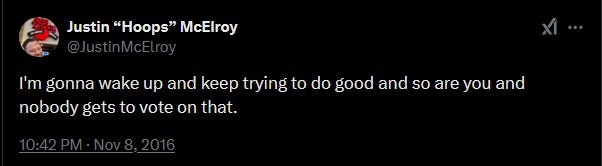
On and off over the last year, I’ve been consciously trying to narrow the scope of… well, for lack of a better term, my sense of responsibility. I have anxiety and OCD, and one of the ways they manifest is as me trying to control every fine detail of every… everything. Things like: what people think of me, how they feel about the things I do, what they want from me, what they could possibly want from me in the future, and how I can deliver it before they even ask—healthy, normal stuff like that.
My various neurodivergencies inspire me to try and account for every possible contingency, even the ones so vanishingly unlikely that no reasonable person would ever bother preparing for them. And while being prepared has its merits, the corollary to this approach is that if something crops up that I haven’t planned for, I feel like a failure—and then I feel like a burden. I’ve made it my purpose in life to have my own business handled, to be easy. When things escape my control, when I need help, then I’ve failed in my purpose. Kinda bleak, I know.
I used to think this mindset was what made me good at my job. I’m still not entirely convinced it’s not, actually, because in a lot of ways, it did me favors. In my previous life as an IT professional, I did a lot of work on the systems that VIPs used every day and expected to “just work.” That meant I had to be invisible, and as much as possible, I couldn’t wait for something to break—I had to fix it before then. I was also responsible for high-visibility special events going off without a hitch, which meant accounting for every unthinkable contingency ahead of time. And every time my paranoia paid off, it was reinforced.
There are a few issues with approaching life this way. For one, it’s awfully inefficient. You’re doing a lot of prep work for things that might not happen, and as the outcomes get increasingly unlikely, your work starts to deliver diminishing returns. For another, when the illusion of control breaks down, it breaks hard and fast, which can leave you brutally blindsided and a little bit frozen. And finally: it’s monstrously stressful.
There’s a theory that I think about at least once a week. It posits that professional burnout is the result of feeling like how hard we work has no meaningful relationship to the outcomes of our work, whether that’s pay, title, respect, efficiency, or some other measure of success. As humans, I firmly believe that we aren’t afraid of hard work; we just want to see that it produces results. And we’ve been told our whole lives that these are the rewards of professional effort. So when they don’t come—or they come arbitrarily—we’re disillusioned and frustrated.
We can lay professional burnout at the feet of poor management, dishonest leaders, and, like… late-stage capitalism in general. But the problem is that in other areas of life—politics, society, relationships—we tend to do the same thing to ourselves, rather than having it imposed on us by societal messaging. We identify the outcomes that we want, and then we judge all our actions and choices by whether they got the right results.
But the outcomes of our actions are rarely the best measure of their value. Or rather—we often choose outcomes that are too far downstream, and too outside of our influence, to measure our actions by. At least, that’s my problem. Regardless of how well I prepared for the event, if a breaker trips and the speakers don’t work, that’s on me; I did a bad job.
So, what to do instead?
For myself, I’m trying to seek outcomes closer to home that I can use as yardsticks for success—ones that are more directly related to what I do and less influenced by the vagaries of, y’know. Everything. Because the truth is, I can’t control (for example) how a client is going to feel when I ask them to pay their invoice—nor do I need to. They’re an adult. As long as I’m not actively rude (and to be honest, even if I was) their reaction is on them. And as for inconveniencing others, well… I don’t require anyone’s permission to exist in the world, and the people who think that I do aren’t worth my time.
As we’re staring down the barrel of a new Trump administration, I find myself applying similar logic. A lot of outrageous, dangerous, stupid, and infuriating things are going to happen over the next four years, and we’re going to wish we had the ability to stop them. That’s normal. But they’ll still happen. And if we let them, they’ll lure us into despair and helplessness and burnout.
But our success in these coming years won’t be measured by whether we can singlehandedly stop an authoritarian machine that’s already in motion. It will be measured by the connections we build and our capacity to care for each other. It will be measured by whether we step up to do for each other the things our government refuses to, and whether we try to minimize the harms on the people in it with us as much as possible.
Justin’s tweet has become something of a mantra in the McElroy podcast fandom, and it’s been grounding for me when I find I’m getting too far away from myself. Because whatever is happening at the national level, all I can really be responsible for is whether I’m trying to do good today. So I’ll try, and I’ll listen, and I’ll improve my efforts, and I’ll try again. And so will you. And nobody gets to vote on that.
One day at a time, one foot in front of the other. Do the best you can. I love you.